Blog
Why We Covered the Aviary Window and What It Teaches Us About Bird Behavior
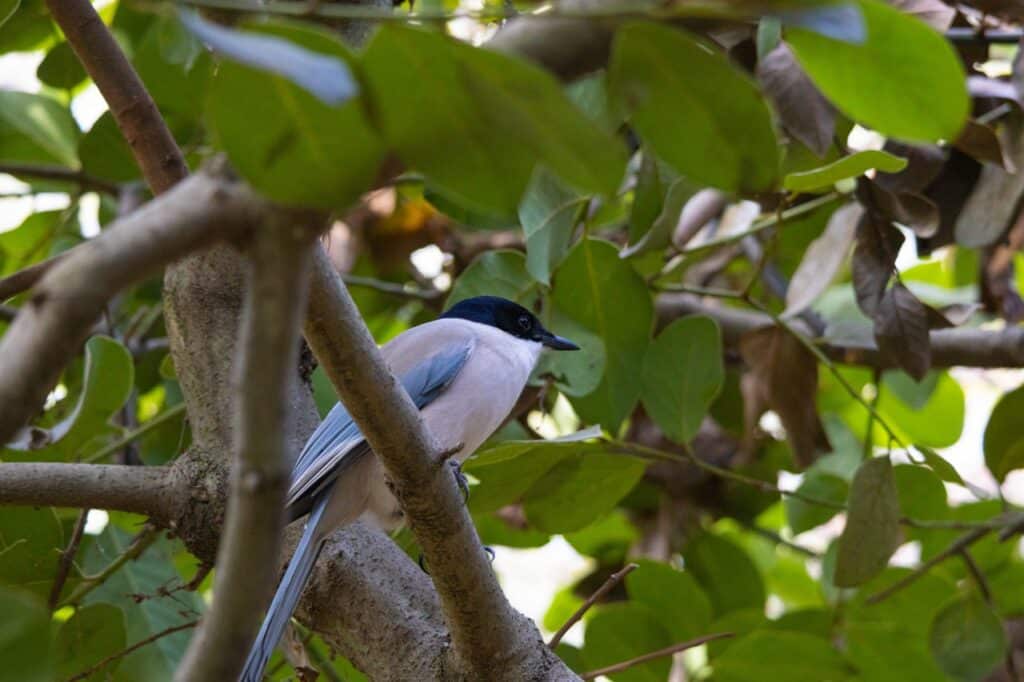
At CuriOdyssey, we’re always learning, not just through our exhibits, but through the behavior of the wildlife around us. Recently, you may have noticed a covered window along the Habitat Hallway adjacent to our walk-through aviary. This isn’t just a temporary fix, it’s a thoughtful measure to protect some of our feathered residents, especially during the breeding and territorial season.
Many birds perceive reflections in glass as other birds intruding on their territory. When a bird, like our azure-winged magpies, see their own reflection, they don’t recognize it as themselves. Instead, it interprets that mirror image as a rival competitor for space, nesting sites, or mates, and reacts accordingly with aggressive behavior. This territorial instinct is especially intense during breeding season, when defending a carefully chosen territory can be critical for raising young.
Because of this powerful instinct, birds sometimes repeatedly peck, fly toward, or even strike reflective glass, believing they are confronting another bird. In some cases, this behavior can be so persistent that the bird becomes stressed or even injures itself. Scientists have observed that these territorial displays, while natural, can be harmful when they’re directed at reflections that don’t retreat or respond.
Here at CuriOdyssey, the safety and well-being of our animals is our top priority. Covering the window reduces the reflection that triggers this response, helping our birds focus on real social and environmental cues rather than a phantom rival. By altering the visual stimulus, we minimize stress and support healthier, more natural behaviors.
This behavior also gives us an opportunity to reflect (pun intended!) on how birds perceive the world differently from humans. Their visual systems are finely tuned to detect movement, color, and light in ways we don’t, which can make a shiny glass surface look like open sky, other birds, or even potential habitat.
We appreciate your curiosity about these adaptations and hope this window-covering becomes a chance to learn more about how wildlife navigates the environments we share. Next time you see a bird flitting around a reflective surface, take a moment to consider the instincts at work and remember that science often begins with observing the world from another creature’s perspective.
Related Posts
Join the CuriOdyssey Community
LOCATION
1651 Coyote Point Drive
San Mateo, CA 94401
Ohlone Land Acknowledgement
650-342-7755
info@curiodyssey.org
CuriOdyssey is a 501(c)(3) non-profit, Tax ID 94-1262434